
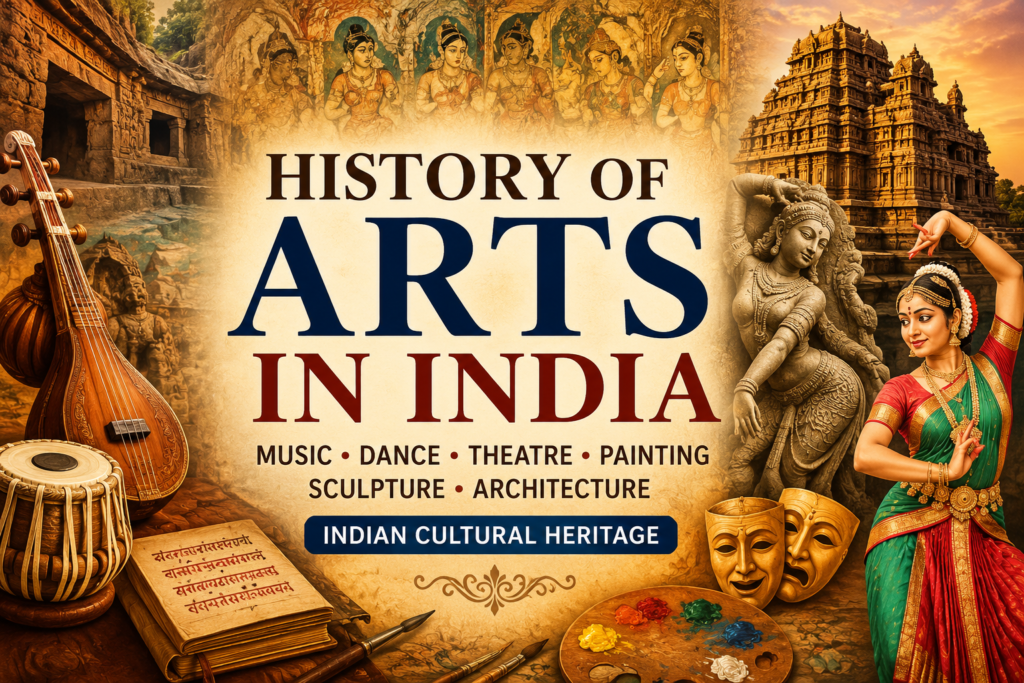
History of Arts in India explained for Class 9 students based on the Class 9 Arts Education curriculum. Learn about Indian music, dance, theatre, painting, sculpture, architecture, cultural heritage, and the evolution of arts from prehistoric times to the medieval period.
History of Arts in India
India is a land of diverse cultures, traditions, and artistic achievements. The History of Arts in India is not just the story of paintings, music, or dance; it is the story of how people expressed their emotions, beliefs, and knowledge through creativity.
From prehistoric cave paintings to magnificent temples and classical music traditions, Indian arts have developed continuously over thousands of years. These artistic traditions form an important part of India’s cultural identity and are also included in the Class 9 Arts Education and Music curriculum.
Understanding the History of Arts in India helps students appreciate the country’s cultural heritage and understand how different art forms evolved together.
Table of Contents
- Introduction to Arts
- Importance of Arts in Human Civilization
- Tangible and Intangible Cultural Heritage
- Major Art Forms in India
- Historical Development of Arts
- Prehistoric Art in India
- Arts in the Indus Valley Civilization
- Vedic Period and Artistic Growth
- Mauryan and Gupta Contributions
- Early Medieval Period and Temple Culture
- History of Indian Music
- Timeline of Indian Arts
- Useful for CBSE and school students
- FAQs
- Conclusion
Introduction to Arts
Art is the creative expression of human thoughts, feelings, imagination, and experiences. Since ancient times, people have used art to communicate ideas, preserve traditions, and celebrate important events.
Arts play a vital role in shaping societies. They help preserve cultural values and create a sense of identity among communities.The History of Arts in India shows how creativity has remained an essential part of Indian civilization from ancient times to the modern world.
Importance of Arts in Human Civilization
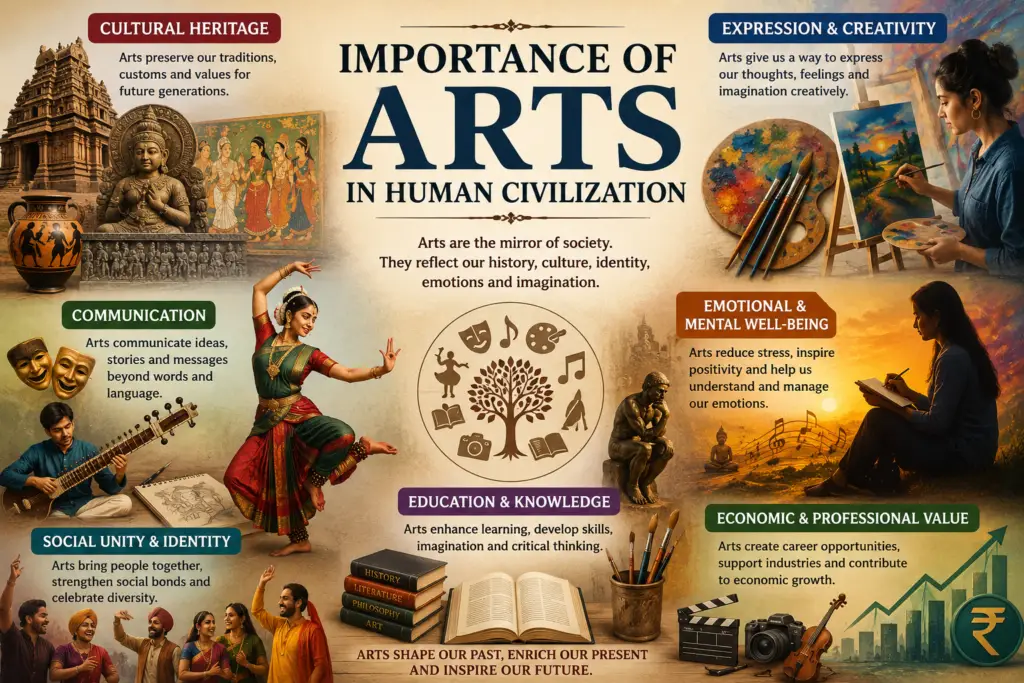
Arts are much more than entertainment. They help people understand history, religion, culture, and social values.
Some important functions of arts include:
- Preserving cultural traditions
- Expressing emotions and ideas
- Educating future generations
- Strengthening community bonds
- Promoting creativity and innovation
Without arts, much of human history would have been lost over time.
Tangible and Intangible Cultural Heritage
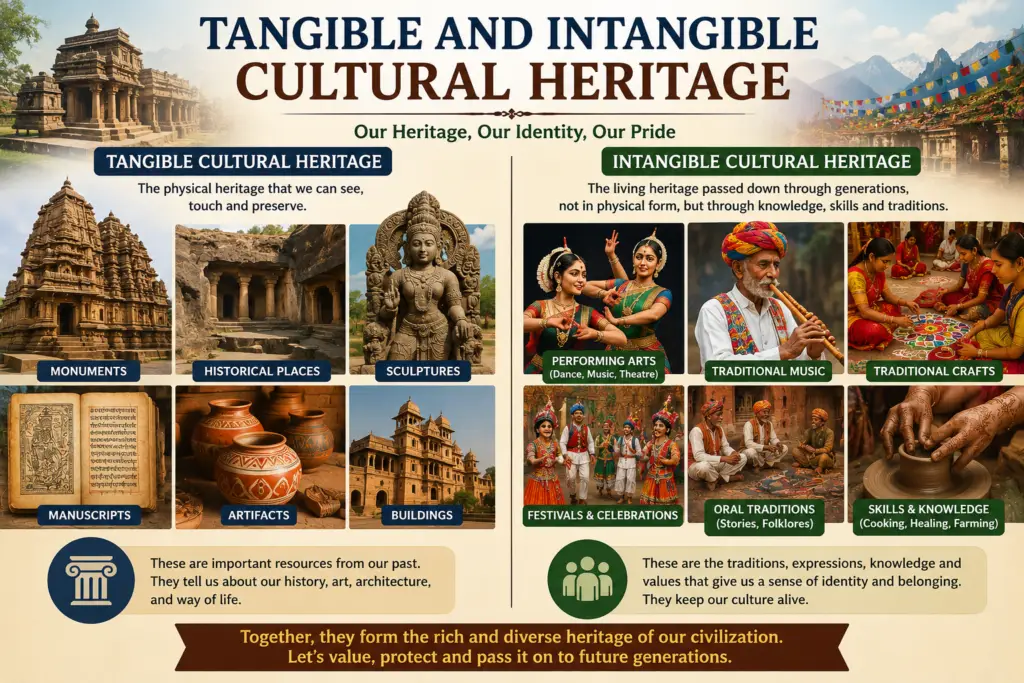
Indian heritage can be divided into two major categories.
Tangible Cultural Heritage
Tangible heritage includes physical objects that can be seen and touched.
Examples include:
- Ancient temples
- Historical monuments
- Sculptures
- Paintings
- Musical instruments
- Archaeological sites
These objects provide evidence of India’s rich artistic traditions.
Intangible Cultural Heritage
Intangible heritage includes traditions and practices passed from one generation to another.
Examples include:
- Music
- Dance
- Theatre
- Folk songs
- Storytelling traditions
- Rituals and festivals
These traditions continue to keep Indian culture alive even today.
Major Art Forms in India
The History of Arts in India includes several important art forms that developed together over centuries.
Music
Music is one of the oldest and most respected art forms in India. It developed from religious chants, folk traditions, and classical systems. Music is used for worship, celebration, education, and entertainment.
Dance
Dance combines rhythm, expression, and movement. Indian classical dance forms such as Bharatanatyam, Kathak, Odissi, Kuchipudi, and Manipuri have gained worldwide recognition.
Theatre and Drama
Theatre is a combination of acting, storytelling, music, and dance. Ancient Indian dramas often presented stories from epics such as the Ramayana and Mahabharata.
Painting
Painting has existed in India since prehistoric times. Cave paintings, murals, and miniature paintings demonstrate the artistic skills of Indian painters.
Sculpture
Indian sculpture developed through religious and cultural influences. Sculptors created beautiful images of gods, goddesses, dancers, and historical figures.
Architecture
Architecture reflects the engineering and artistic achievements of Indian civilization. Temples, stupas, forts, caves, and monuments are examples of India’s architectural excellence.
Historical Development of Arts in India
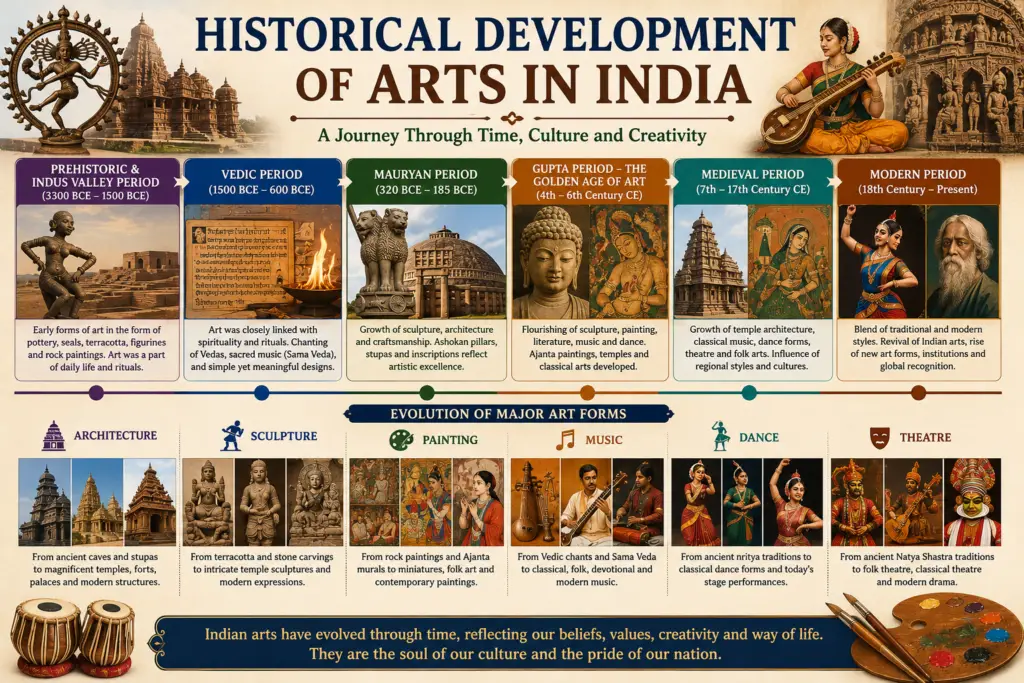
The development of Indian arts can be understood through different historical periods.
Period | Major Artistic Developments |
Prehistoric Period | Cave paintings and primitive music |
Indus Valley Civilization | Sculpture, pottery, urban design |
Vedic Period | Sacred music and rituals |
Mauryan Period | Stone architecture and sculpture |
Gupta Period | Golden Age of arts and culture |
Early Medieval Period | Temple arts and classical traditions |
Prehistoric Art in India
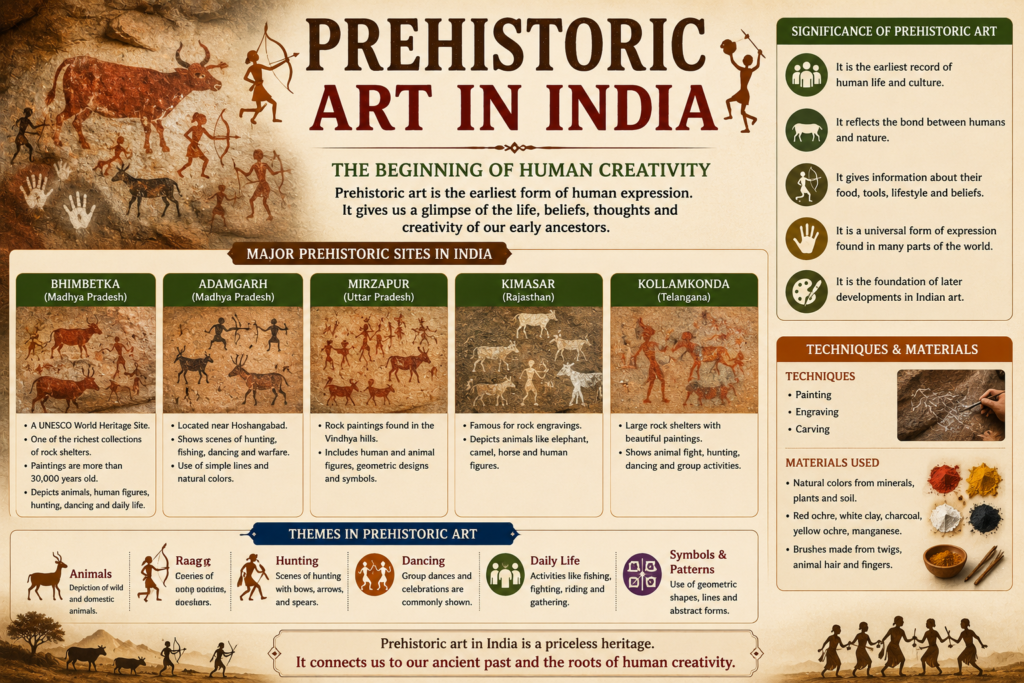
The earliest evidence of art in India comes from prehistoric times.
Bhimbetka Rock Shelters
The Bhimbetka caves in Madhya Pradesh contain some of the oldest paintings in India. These paintings show:
- Hunting scenes
- Animals
- Community activities
- Ritual performances
These artworks reveal how early humans used art to express their experiences and beliefs.
Early Music and Dance
Although no written records exist, historians believe that prehistoric communities used:
- Drums made from animal skins
- Rhythmic clapping
- Singing
- Group dances
These practices became the foundation of later artistic traditions.
Arts in the Indus Valley Civilization
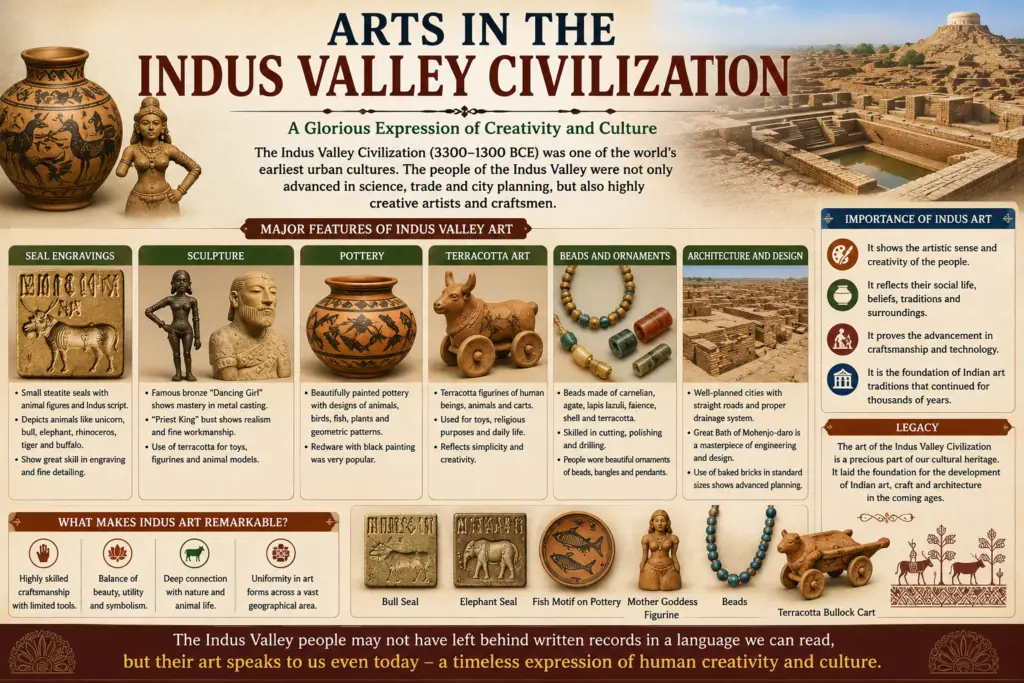
The Indus Valley Civilization (2500–1900 BCE) demonstrated advanced artistic skills.
Sculpture
The famous Dancing Girl statue discovered at Mohenjo-Daro is one of the most remarkable examples of ancient Indian sculpture.
Pottery
Decorated pottery reflects creativity and craftsmanship.
Architecture
Well-planned cities with drainage systems demonstrate advanced engineering and architectural knowledge.
Artistic Significance
The civilization shows that arts were already an important part of daily life thousands of years ago.
Vedic Period and Artistic Growth
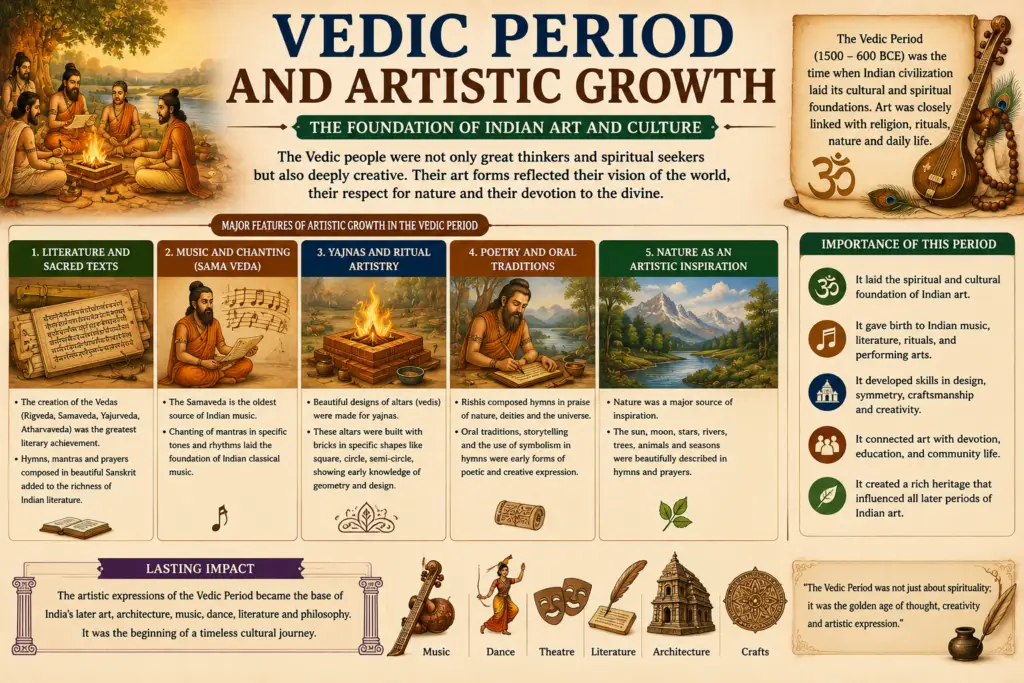
The Vedic Period played a crucial role in shaping Indian arts, especially music.
Religious Influence
Religious ceremonies involved singing sacred hymns and performing rituals.
Sama Veda and Music
The Sama Veda is considered the foundation of Indian music. Priests chanted hymns using specific melodic patterns.
These musical practices later influenced the development of Indian classical music.
Oral Tradition
Knowledge was passed orally from teacher to student, ensuring the preservation of artistic traditions.
Mauryan and Gupta Contributions Mauryan Period
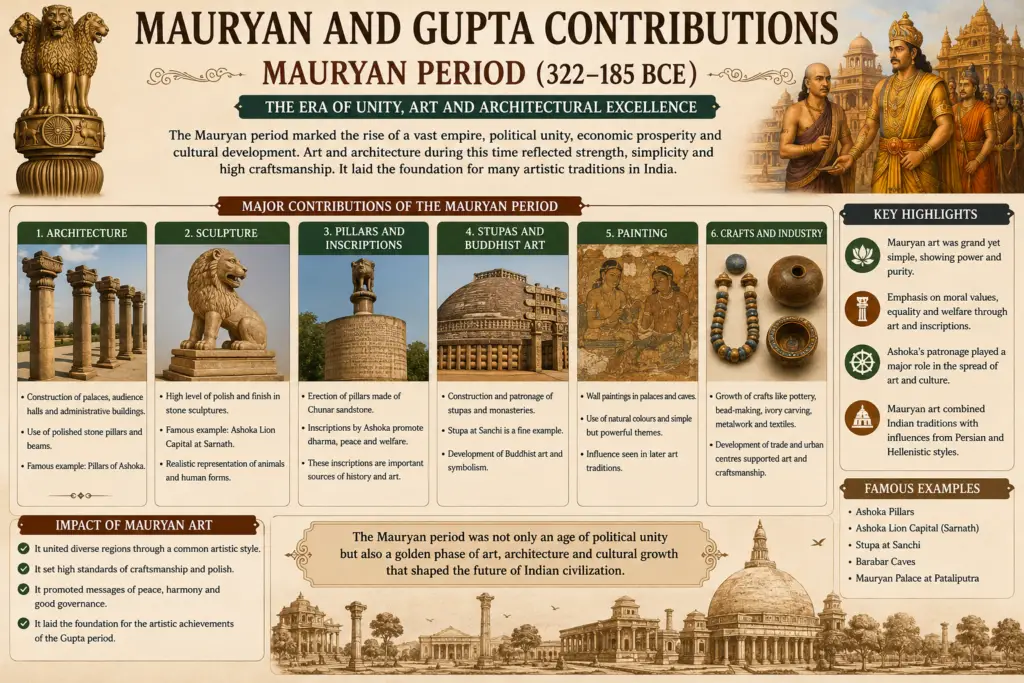
The Mauryan Empire encouraged architecture and sculpture.
Famous examples include:
- Ashokan pillars
- Stupas
- Rock-cut structures
Gupta Period
The Gupta Age is often called the Golden Age of Indian Arts.
During this period:
- Literature flourished
- Sculpture reached new heights
- Classical music developed further
- Temple architecture became more sophisticated
The Gupta Period laid the foundation for many artistic traditions that continue today.
Early Medieval Period and Temple Culture
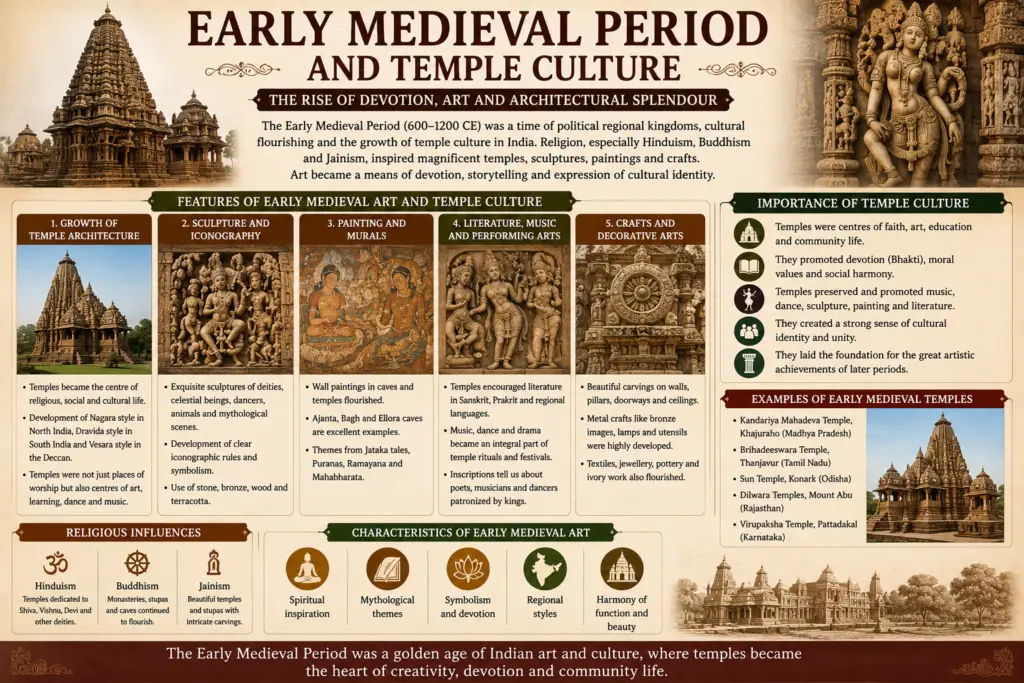
Between the 7th and 11th centuries CE, temples became centers of artistic activity.
Temples supported:
- Musicians
- Dancers
- Sculptors
- Painters
- Architects
Art was closely connected with religion and community life.
Temple walls often displayed sculptures of musicians and dancers, showing the close relationship between different art forms.
Why Temple Culture Was Important
Temple culture helped preserve:
- Classical music
- Dance traditions
- Sculpture
- Architecture
- Storytelling traditions
This period played a major role in safeguarding India’s artistic heritage.
History of Indian Music- The Heart of the History of Arts in India
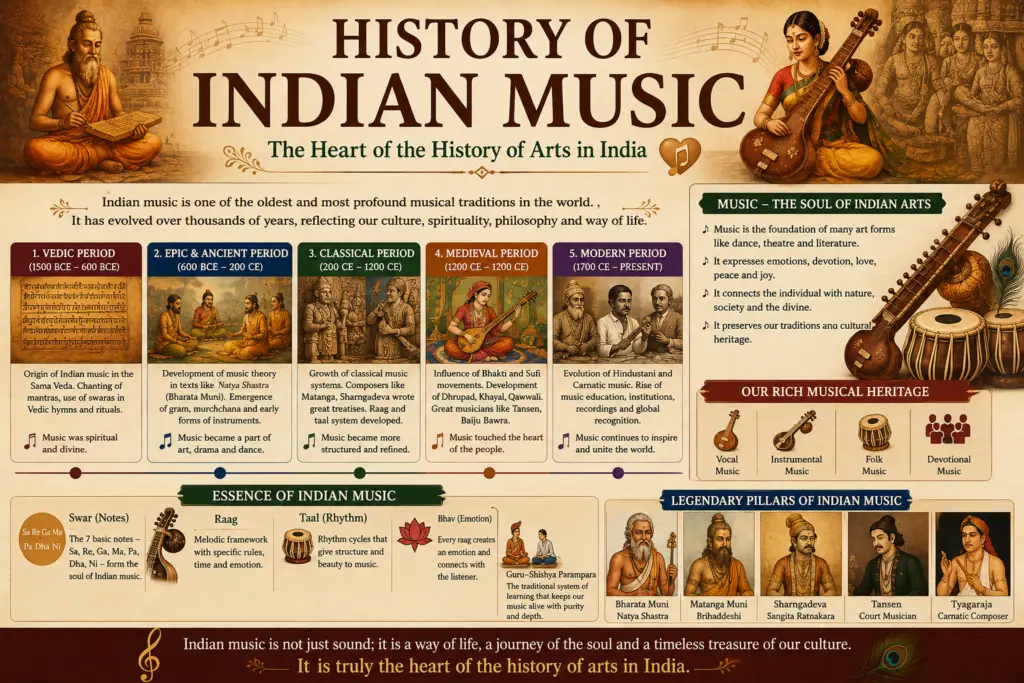
Among all Indian art forms, music occupies a special place. The History of Arts in India cannot be understood without understanding the development of Indian music. Music has always been associated with spirituality, education, culture, and social life.
Today, Indian music is admired throughout the world, but its roots go back thousands of years.
Origin of Indian Music
The origin of Indian music can be traced to nature and early human civilization. Ancient people observed sounds produced by birds, flowing rivers, rainfall, wind, and animals. These natural sounds inspired the earliest forms of music.
In prehistoric communities, music was used during:
- Religious rituals
- Celebrations
- Harvest festivals
- Community gatherings
- Storytelling performances
Over time, these simple sounds evolved into organized musical systems.
Sama Veda- Foundation of Indian Music
The Sama Veda is considered the earliest source of Indian music.
Unlike other Vedas, the Sama Veda contains hymns designed to be sung rather than simply recited.
Importance of Sama Veda
- Introduced melodic chanting.
- Established the connection between music and spirituality.
- Influenced the development of classical music traditions.
- Preserved musical knowledge through oral transmission.
Because of its contribution, the Sama Veda is often called the foundation of Indian classical music.
Natya Shastra and Indian Performing Arts
One of the most important milestones in the History of Arts in India is the composition of the Natya Shastra by Bharata Muni.
The Natya Shastra is an ancient text that explains:
- Music
- Dance
- Drama
- Rhythm
- Emotions (Rasa)
- Stage performance
Why Is Natya Shastra Important?
The text provided a scientific approach to performing arts. Many principles used in Indian classical music and dance today are based on concepts explained in the Natya Shastra.
It helped unite different art forms under one comprehensive framework.
Development of the Raag System
The development of the Raag system was a major achievement in the History of Indian Music.
What Is a Raag?
A Raag is a specific arrangement of musical notes designed to create a particular mood, feeling, or atmosphere.
Each Raag has:
- Specific notes
- Ascending and descending patterns
- Emotional characteristics
- Preferred performance times
Importance of Raags
Raags allow musicians to express emotions such as:
- Joy
- Peace
- Devotion
- Love
- Courage
- Sadness
Over centuries, hundreds of Raags were developed and preserved through the Guru-Shishya tradition.
Temple Music Traditions
Temples played a crucial role in preserving music.
During the early medieval period, temples became cultural centers where musicians and dancers regularly performed.
Functions of Temple Music
- Religious worship
- Festivals
- Community gatherings
- Preservation of artistic traditions
Many devotional songs and musical traditions practiced today have roots in temple culture.
Folk Music and Classical Music Traditions
Indian music developed into two major streams.
Folk Music
Folk music reflects the daily life of ordinary people.
Characteristics include:
- Regional languages
- Local customs
- Seasonal festivals
- Community participation
Examples include:
- Punjabi Folk Music
- Rajasthani Folk Songs
- Baul Music of Bengal
- Lavani of Maharashtra
Classical Music
Classical music follows established rules and structures.
It emphasizes:
- Raag
- Taal
- Improvisation
- Musical discipline
Indian classical music later developed into two major traditions:
- Hindustani Classical Music
- Carnatic Classical Music
Both traditions continue to preserve ancient musical knowledge.
Relationship Between Different Arts
One unique feature of the History of Arts in India is that different art forms evolved together.
Music and Dance
Dance requires music for rhythm and expression. Without music, classical dance performances lose much of their emotional impact.
Music and Theatre
Ancient dramas included songs, instrumental music, and dance performances.
Sculpture and Painting
Many sculptures and paintings depict musicians playing instruments or dancers performing artistic movements.
Temples as Cultural Centers
Temples served as centers where all art forms flourished together.
This close connection demonstrates that Indian arts were never isolated from one another.
Timeline of the History of Arts in India
Period | Major Development |
Prehistoric Period | Cave paintings and primitive music |
2500–1900 BCE | Indus Valley artistic achievements |
1500–500 BCE | Vedic music traditions |
200 BCE–200 CE | Natya Shastra composition |
320–550 CE | Gupta Golden Age |
600–1100 CE | Temple arts and music traditions |
Present Day | Preservation of Indian cultural heritage |
Key Points based on the Class 9 Arts Education curriculum Remember These Important Facts
- Art is a form of creative expression.
- Bhimbetka contains prehistoric cave paintings.
- The Dancing Girl statue belongs to the Indus Valley Civilization.
- Sama Veda is considered the foundation of Indian music.
- Bharata Muni wrote the Natya Shastra.
- Raag is a specific arrangement of musical notes.
- Temples preserved music, dance, sculpture, and architecture.
- Folk music reflects regional culture.
- Classical music follows established musical rules.
Multiple Choice Questions (MCQs)
1. Which Veda is considered the foundation of Indian music?
A. Rig Veda
B. Yajur Veda
C. Sama Veda
D. Atharva Veda
Answer: C. Sama Veda
2. Who wrote the Natya Shastra?
A. Kalidasa
B. Bharata Muni
C. Tansen
D. Chanakya
Answer: B. Bharata Muni
3. The Dancing Girl statue belongs to:
A. Gupta Period
B. Mauryan Period
C. Indus Valley Civilization
D. Vedic Period
Answer: C. Indus Valley Civilization
4. What is a Raag?
A. A musical instrument
B. A dance form
C. A pattern of musical notes
D. A sculpture
Answer: C. A pattern of musical notes
5. Bhimbetka is famous for:
A. Temples
B. Paintings
C. Music schools
D. Stupas
Answer: B. Paintings
Frequently Asked Questions
What is the History of Arts in India?
What is the History of Arts in India?
It is the study of the development of music, dance, theatre, painting, sculpture, and architecture in India from ancient times to the present.
Why is the History of Arts in India important?
It helps us understand India’s cultural heritage and artistic traditions.
What is intangible cultural heritage?
It includes music, dance, theatre, folk traditions, and oral storytelling.
Why is the Sama Veda important?
The Sama Veda introduced melodic chanting and influenced Indian classical music.
Who was Bharata Muni?
Bharata Muni was the author of the Natya Shastra, an important text on performing arts.
What is a Raag?
A Raag is a structured arrangement of musical notes that creates a specific mood.
Why is the History of Arts in India included in CBSE Class 9?
It helps students understand India’s artistic and cultural heritage.
Conclusion
The History of Arts in India is a remarkable journey of creativity, knowledge, and cultural expression. From prehistoric cave paintings to sophisticated systems of music and architecture, Indian civilization has continuously nurtured artistic excellence.
Music, dance, theatre, painting, sculpture, and architecture developed together and influenced one another. Among these art forms, music holds a special place because it connects spirituality, emotion, and cultural identity.
For CBSE Class 9 students, studying the History of Arts in India provides valuable insight into the country’s rich heritage and inspires appreciation for the artistic traditions that continue to thrive today.
India’s artistic legacy is not merely a part of history—it remains a living tradition that continues to inspire people across the world. Students can also explore the official CBSE Art Education curriculum for Class 9 on the CBSE Academic Website for syllabus reference.